Yes, AI content works for SEO if it’s done in the right way. Google accepts the use of AI-generated content, as long as it’s done ethically. It does not penalize our website for using AI-generated content.
Have you ever heard about AI tools like ChatGPT or Jasper? These are smart tools that can write articles, product descriptions, and even emails. To succeed online, it’s important to understand what SEO is, which is the process of optimizing content so it ranks higher in search results, and how Semantic Search has changed SEO by focusing more on the intent behind a search rather than just exact keywords.
With so many people using them, one big question comes up: Does AI content work for SEO, and what to know about AI content? That’s what we’re going to explore.
These days, getting websites to appear on Google is harder than ever. Every business is trying for online attention. So, many people are using AI for help. It’s faster, cheaper, and always available. But Google has its own rules. It wants to show content that truly helps people. That’s why this topic is so important. We’ll walk through what Google says about AI content, what works, what doesn’t, and how to stay on the safe side while using these powerful AI tools.
What is AI-generated Content?
Text created by a computer program rather than a human is known as AI-generated content. It mimics human writing using sophisticated algorithms and natural language processing (NLP). For instance, we could not even be aware that a computer program wrote a blog article we read online!
Is AI-Generated Content Good or Bad for SEO?
Is it wise or dangerous to use AI to produce content for websites? It’s not a clear-cut solution. The Google Search team, which includes professionals like Danny Sullivan and Chris Nelson, believes that the quality of the material matters more than who created it. Google doesn’t care if a robot or a person created the material as long as it is beneficial to readers.
Does AI Content rank in Google Search?
Yes, our material will rank if it follows the Google Framework. E-E-A-T, which stands for Experience, Expertise, Authoritativeness, and Trustworthiness, is the structure that Google employs.
AI is great at data, but it frequently fails to show practical experience or build strong trust, especially in fields like health or finance. A personal touch is still important in this situation. An AI, for instance, may explain how a product functions, but it is unable to communicate an actual customer’s experience.
Additionally, Google offers website scanning technologies like SpamBrain and the Helpful Content System. Our website may lose its ranking if they discover overused AI material, duplicate content, or indications that we are attempting to trick the algorithm in order to rank higher.
AI has the potential to be very beneficial, but it may also be detrimental if it is used incorrectly, such as when it produces thin material or stuffs it with keywords. We have a better chance of remaining in Google’s favor if we combine AI with human insights, thought leadership, and creative ideas.
How does AI affect SEO?
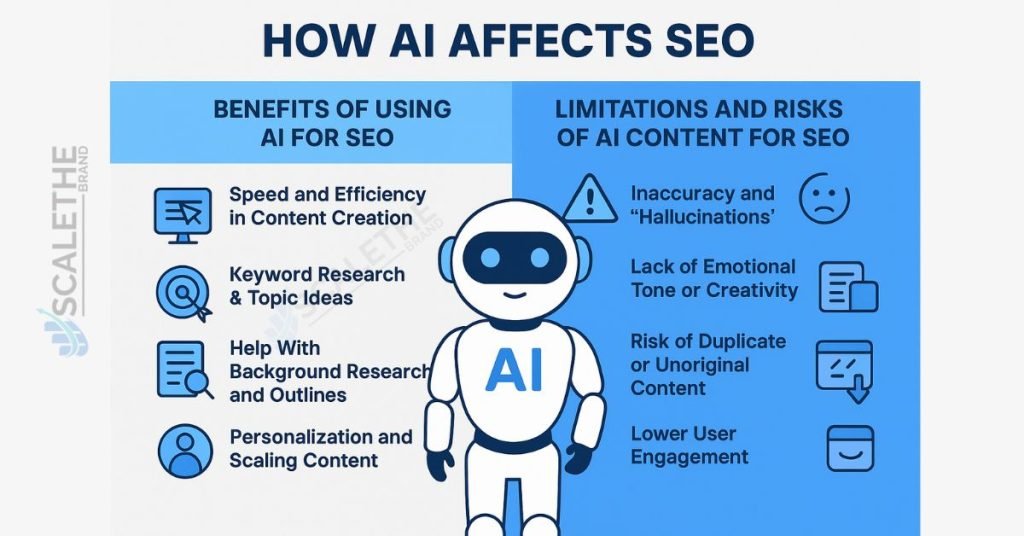
The use of AI for SEO can be beneficial and harmful. Let’s explore both of these aspects.
➥ Benefits of Using AI for SEO
The use of AI for SEO saves a lot of time and effort, and it’s a secret behind the success of many online businesses. Some benefits of AI for SEO are explained below:
Speed and Efficiency in Content Creation
AI tools like ChatGPT, Jasper, and SEOwind can write blog posts, emails, and even social media captions in minutes.
Keyword Research & Topic Ideas
Some AI-powered platforms, like Surfer, help us figure out which keywords our audience is searching for, a major part of learning how to do keyword research. These tools show us what topics people are interested in, how competitive the keywords are, and how we can structure our content around those keywords to boost visibility.
Help With Background Research and Outlines
AI scans large amounts of data and gives facts and figures in seconds. With prompt engineering, we can use AI to generate content in different tones or formats. Many marketers even use it for dynamic A/B testing, trying out different headlines or intros to see which works better. Headlines written by AI give a 59% higher click-through rate (CTR) in some marketing tests.
Personalization and Scaling Content
If we want to write blog posts for different buyer personas or industries? AI can personalize content based on location, behavior, or user interest.
➥ Limitations and Risks of AI Content for SEO
While AI tools offer benefits, they also have some limitations. If we’re relying only on AI, here are a few risks to be aware of:
Inaccuracy and “Hallucinations”
When the tool gives false or outdated information as if it’s true, this is called AI hallucination. For example, it might say a product is available in 2025 when it’s not or give incorrect medical or legal facts. This damages our credibility and confuses our readers.
Lack of Emotional Tone or Creativity
AI is good at different writing styles but struggles with human feelings. It misses the emotional tone that connects with real people. Don’t expect rich storytelling, humor, or empathy until a human edits and polishes it.
Risk of Duplicate or Unoriginal Content
If we do not do proper editing, we might end up with duplicate content, which Google does not rank. If we repeat the content that’s already there, it will hurt our ranking.
Lower User Engagement
AI content might not hold our readers’ attention. Google checks dwell time (how long users stay on a page). If people leave quickly, it’s a negative signal. If our content feels fake, people won’t return to our site.
How can AI Work for SEO?
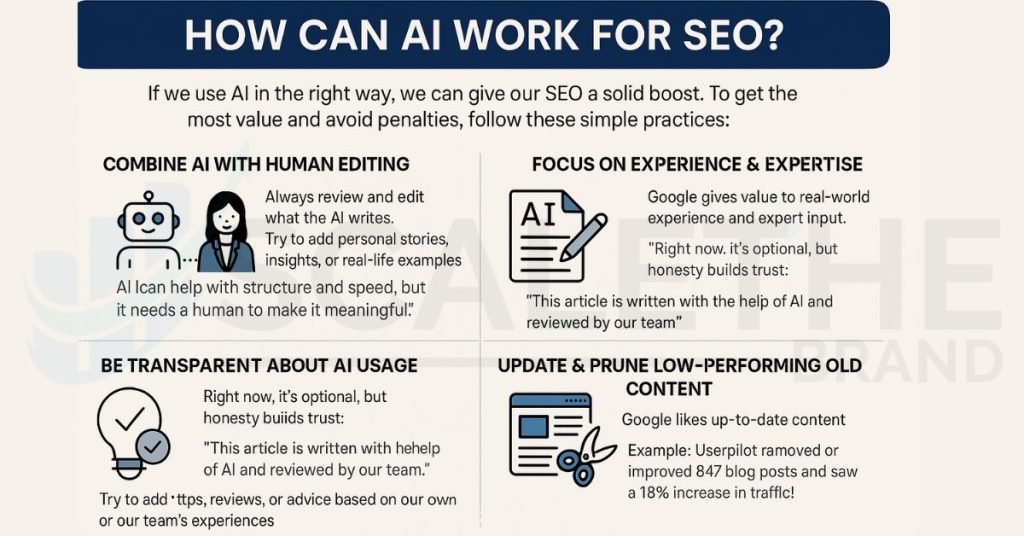
If we use AI in the right way, we can give our SEO a solid boost. To get the most value and avoid penalties, follow these simple practices:
Combine AI with Human Editing
AI is fast, but it’s not perfect.
- Always review and edit what the AI writes. Try to add personal stories, insights, or real-life examples.
- SEO expert Sarah Berry says, “AI can help with structure and speed, but it needs a human to make it meaningful.”
- Rory Hope also advises mixing human expertise with AI to maintain credibility.
Be Transparent About AI Usage
Do we have to tell readers our content is written with AI?
- Right now, it’s optional, but honesty builds trust.
- We might say something like: “This article is written with the help of AI and reviewed by our team.”
Focus on Experience & Expertise
Google gives value to real-world experience and expert input.
- AI can’t talk about using a product or living through a real situation.
- Try to add tips, reviews, or advice based on our own or our team’s experiences.
Keep Content Original and Fresh
Don’t just copy what’s already out on Google.
- Try to use brand tone, customer examples, or a fresh point of view.
- Use different tools to make sure our content is unique.
Update & Prune(low performing) Old Content
Google likes up-to-date content.
- Try to review older pages and refresh outdated info.
- Example: Userpilot removed or improved 847 blog posts and saw a 16% increase in traffic!
Practical Ways to Use AI Tools for SEO
AI isn’t just for writing blog posts. It helps us at every stage of our SEO strategy. From finding the right topics to improving click rates, here are some easy, real-world ways we can use AI tools in our business:
Generate Keyword Clusters and Topic Ideas
AI tools like Semrush, SEOwind, and Surfer can help us figure out:
- What keywords our audience is searching for
- How to group them into smart clusters
- What questions do people ask on Google
Create Outlines and Draft Structure
Once we select a topic, we use HubSpot AI or ChatGPT to generate a complete outline in seconds:
- We’ll get heading ideas, subtopics, and even bullet points to cover.
- This saves hours of planning time and keeps content well-organized from the start.
Optimize Meta Titles and Descriptions
AI tools can generate SEO-friendly titles and meta descriptions that help our page get noticed in search results:
- Tools like Surfer SEO or Jasper can create different versions.
- Then, we can test which one gets more clicks.
A/B Test Headlines
Want to know which headline works best? Use AI for A/B testing.
- For example, in a real case study, headlines written by ChatGPT won 46% of the A/B tests, meaning they got more clicks than human-written ones.
- Try two different headline styles and see which performs better using tools like Causal or even Google Ads.
Analyze Competitors and Find Content Gaps
AI can also scan our competitors’ websites and show us what they’re doing right and what they’re missing.
- Tools like ScrapingBee make it simple to gather this data.
- One company, TV 2 Fyn, used AI to analyze competitor content and fill in missing topics, which helped them attract more readers.
AI Content Use Cases That Work Well
AI can be a great helper, especially when used in the right way. Here are a few types of content where AI shines, as long as a human reviews and fine-tunes it.
- Educational and How-To Guides
AI is excellent at writing step-by-step guides or explaining simple topics. For example, “How to start a blog” or “How to set up an email list” can be easily written by tools like ChatGPT or Jasper.
- Product Descriptions (With Human Oversight)
If we have to write dozens of product descriptions, AI can easily write them. It can describe features, benefits, and even suggest keywords.
- SEO Audits and Technical Optimization
Some tools, like Surfer or SEOwind, can analyze our website and give helpful SEO tips. AI suggests internal links, keyword placements, or improvements in page structure
- Data-Rich Summaries (Stats & Timelines)
If we need to summarize a report or show trends over a long period, AI can handle that well.
Level up your Content Creation
If you need help scaling up your content creation without risking your SEO strategy due to low-quality AI content, or you’re simply looking for affordable SEO services for your business, we’re here to support you. Contact ScaleTheBrand, your trusted partner in high-impact content and SEO growth. At ScaleTheBrand, our expert copywriting team crafts content that ranks, engages, and converts, fueling real business results.
Explore our SEO content marketing services, and request a quote to discover how we can help you grow your brand with confidence.
Final Thoughts of Does AI Content work for SEO?
AI content can help with SEO, but only if it is used properly. It makes little difference if the material was created by a human or an AI tool as long as it is useful, unique, and reader-focused. Google considers quality rather than the underlying technology. But keep in mind that hurried, repetitious, or deceptive AI material might lower our results.
When we combine the speed of AI with our own experiences and ideas, the true magic occurs. That’s what distinguishes our brand, fosters reader engagement, and increases trust. I think you will now understand whether or not AI content is effective for SEO.
Frequently Asked Questions
Here are some answers to common questions
What is Google’s stance on AI content?
Google’s official stance is clear: “ Use of AI or automation in the right way is not against our guidelines.”
Why does Google allow AI content?
Google recognizes that AI can enhance content creation: “AI assists in generating useful content in exciting new ways.”For years, automation has been used to generate reliable content like weather updates, sports scores, and finance reports.
Does AI content rank in Google Search?
Yes, AI-generated content can rank in Google Search. According to Google: “If AI content is helpful, original, and satisfies aspects of E-E-A-T, it might do well in Search. If it doesn’t, it might not.”
Does Google penalize AI content?
Yes!Only if it’s used to spam or deceive. Avoid shortcuts. Use AI to assist in quality creation, not as a spam tool.
Can we use AI to write a whole blog?
Yes! But it’s not recommended without human oversight. AI can help us brainstorm, draft, or outline, but final editing should involve a person to ensure clarity, tone, and accuracy.