
“Your content might be great, but if Google isn’t noticing, it’s like talking to an empty room.” Meanwhile, your competitors are racing up the search results. The reason? They’re getting more quality backlinks. In 2025, two popular ways to build these links are niche edits and guest posts.
Both can help your SEO grow, but which one gives you better results, and which could hurt your rankings if done wrong? Before we compare guest posting and niche edits, it’s worth understanding what is SEO and why link building is a crucial part of it. Let’s find out.”
Understanding the Niche Edits vs Guest Post
What Is Guest Posting?
Writing a new, valuable article for another website in your area is the art of guest posting, sometimes referred to as guest blogging. You usually receive a hyperlink (either in the author bio or organically weaved into the piece) in exchange for providing pertinent, high-quality material.
You should pick your anchor text carefully and focus on websites with high Domain Authority (DA). This white hat SEO strategy can improve your brand’s trustworthiness and search engine rankings. Additionally, this will create opportunities for partnerships with other top business executives. It’s a win-win situation where you acquire authority and visibility while the host site receives excellent material.
What Are Niche Edits (Curated Links / Link Insertions)?
Niche edits, sometimes called curated links or link insertions, work differently. Instead of creating a brand-new post, your backlink is strategically added to already-published, indexed content on an authoritative, relevant website.
This allows you to tap into the existing link juice, relevance, and Domain Rating (DR) that the page has already earned. Because the content is already ranking and trusted by search engines, niche edits often deliver faster SEO results than guest posting, making them a powerful tool in your off-page strategy.
Why These Strategies Still Matter in SEO Today
High-quality backlinks are still a significant ranking factor in 2025, which may be explained by an understanding of how search engines operate. High-quality link development is more important than ever because Google’s algorithms now highly favor relevance, authority, and user-first content based on concepts like E-E-A-T (Experience, Expertise, Authoritativeness, Trustworthiness).
Niche edits and guest blogging continue to be two of the best white hat off-page SEO strategies. When implemented properly, they may improve your brand’s search engine results, provide steady referral traffic, and strengthen your brand’s standing as a reliable expert in your industry.
How Each Strategy Works in Practice
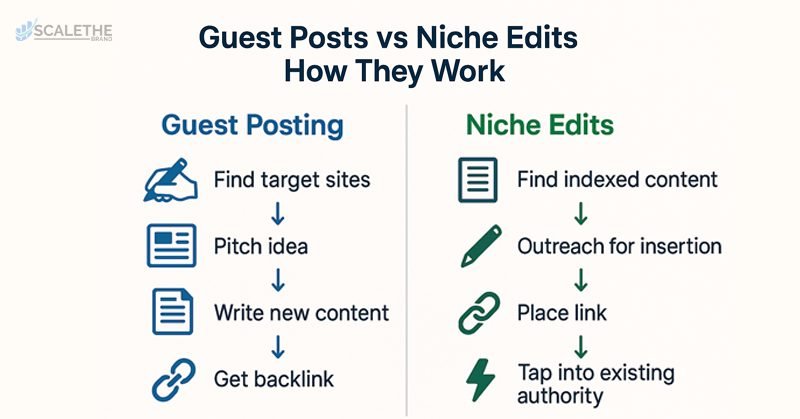
Step-by-Step Guest Posting Process
Finding Target Sites
The first step in guest posting is finding the right websites, ones that are both authoritative and relevant to your niche. Look for sites that openly welcome contributors by using Google search operators such as:
- “your niche” + “write for us”
- “your niche” + “guest post”
You can also explore guest post directories like Backlink Manager, Website Rating, or Bloggers Passion. For a competitive edge, use tools like Ahrefs or SEMrush to run competitor backlink analysis and uncover where they’ve published guest posts. Many SEO experts start by mastering how to do keyword research before selecting target sites, ensuring the guest post aligns with both the host’s audience and ranking potential.
Pitching and Content Creation
Once you’ve identified your targets, it’s time to reach out. Send a personalized outreach email that explains your content idea, how it benefits their audience, and showcases examples of your previous work.
If they accept, create high-quality, original content tailored to their editorial guidelines. Make sure it’s rich in relevant keywords, matches their audience’s needs, and naturally integrates your backlink in a way that adds genuine value. Even seasoned marketers sometimes revisit how to write an article guide to ensure their guest posts are engaging, well-structured, and audience-focused.
Anchor Text Optimization and Link Placement
Choosing the right anchor text is critical. Align it with your target page’s focus keyword, but avoid over-optimization to stay in line with Google Webmaster Guidelines.
For maximum SEO value, aim to place your backlink contextually within the main body of the article rather than limiting it to the author bio. This not only strengthens your link equity but also improves user engagement.
Step-by-Step Niche Edits Process
Identifying Relevant Indexed Content
The power of niche edits lies in tapping into content that’s already performing well. Start by using tools like Ahrefs, SEMrush, or Google search filters to find indexed, high-ranking articles in your niche. Look for pages with a strong Domain Rating (DR), steady organic traffic, and clear topical relevance to your target page. These factors ensure that your backlink inherits valuable link equity and relevance from an already trusted source.
Outreach for Link Insertion
Once you’ve identified a target page, reach out to the site owner or editor with a personalized pitch. Explain exactly how adding your link will enhance the article, whether by offering updated statistics, additional insights, or a useful resource that benefits their readers. This positions your request as an added value rather than a simple self-promotion, making acceptance far more likely.
Adding Value Without Rewriting the Whole Article
Unlike guest posting, niche edits don’t require creating an entirely new piece. Instead, you strategically insert your backlink into the existing content where it feels natural and contextually relevant. You might add a short supporting paragraph or refresh a resource section, ensuring the link improves the reader experience, flows with the narrative, and passes SEO authority seamlessly.
Head-to-Head Comparison – Guest Posts vs Niche Edits
SEO Impact & Link Juice Transfer
Both guest posts and niche edits improve SERP rankings by passing link equity, also known as link juice, from high-authority sites to your domain.
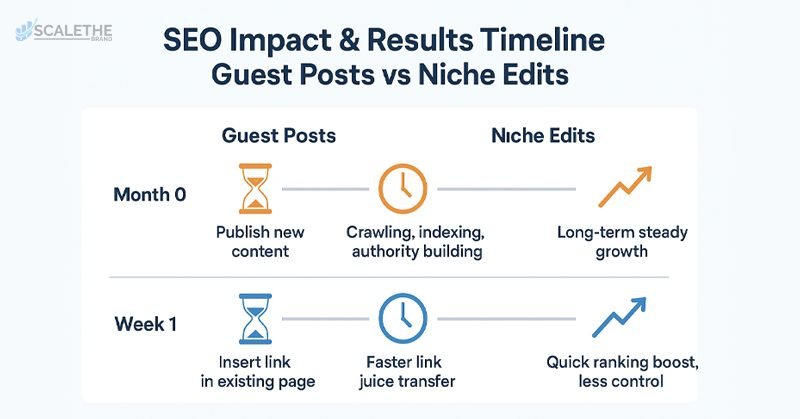
▸ Guest Posts: Give you full control over anchor text, content relevance, and keyword targeting. The trade-off? Because the article is brand new, it takes time for search engines to crawl, index, and trust it before the link passes its full value.
▸ Niche Edits: Tap into already-indexed, high-DR content, meaning the link juice transfer happens almost instantly. This often results in faster ranking improvements, especially for competitive keywords.
Time to See Results
▸ Guest Posts: Typically take 2–6 months to deliver measurable organic traffic growth. That’s because the page must first be crawled, indexed, and gradually build authority.
▸ Niche Edits: Often show movement in just a few weeks. Since the content is already ranking and enjoys a healthy crawl frequency, your backlink gets noticed and valued by Google much faster.
Cost & Resource Requirements
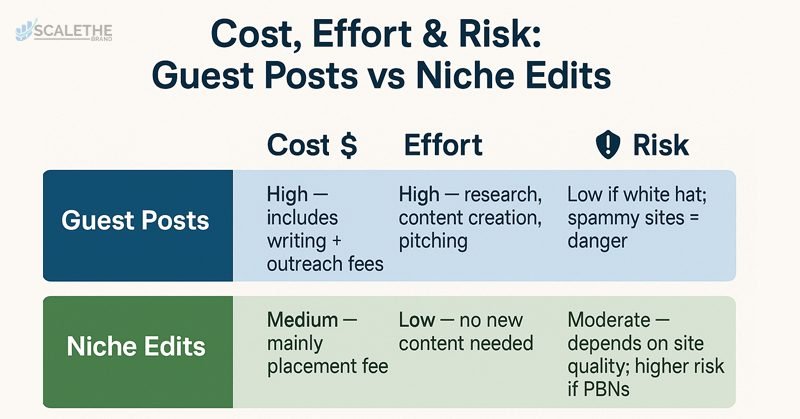
▸ Guest Posts: Usually come with a higher price tag due to content creation (research, writing, editing) and outreach. If outsourcing to freelance writers or agencies, your cost per link can rise further.
▸ Niche Edits: Generally, more budget-friendly because you skip the writing process. Costs mainly involve outreach and the link placement fee, which varies based on the site’s Domain Authority (DA), traffic source relevance, and audience size.
Link Longevity & Stability
▸ Guest Posts: Often remain live for years, especially if published on reputable sites that maintain a content archive of all articles.
▸ Niche Edits: Can be long-lasting too, but depend on the host page staying published. If the article is updated or removed, your link could disappear, making link retention slightly more uncertain.
Risk Factors
▸ Guest Posts: Low risk when done via white hat SEO, targeting relevant, authoritative sites, and avoiding over-optimized anchors. Risks arise when posting on spammy or irrelevant blogs.
▸ Niche Edits: Slightly higher risk if you place links in unrelated content or purchase from Private Blog Networks (PBNs). Google may view this as part of a link scheme, leading to manual penalties or devaluation of the link.
Pros & Cons at a Glance
Guest Posting – Advantages & Drawbacks
Advantages
▸ Full Content Control: You choose the topic, keyword targeting, and anchor text, keeping everything aligned with your SEO strategy.
▸ Brand Authority Building: Publishing on high-Domain Authority (DA) sites boosts your E-E-A-T (Experience, Expertise, Authoritativeness, Trustworthiness) signals in Google’s eyes.
▸ Relationship Opportunities: Opens doors to collaborations with industry influencers, bloggers, and site owners.
▸ Long-Term SEO Value: A well-written guest post can drive steady organic traffic and referral visits for years.
Drawbacks
▸ Slower Results: New content takes time to be crawled, indexed, and trusted before delivering ranking improvements.
▸ Higher Costs: Requires content creation, plus possible editorial or placement fees.
▸ Approval Uncertainty: Your pitch may be rejected, or the host site may edit your links.
▸ Scalability Limits: Each post demands significant research, writing, and outreach effort.
Niche Edits – Advantages & Drawbacks
Advantages
▸ Faster Results: Your link is placed in indexed, high-ranking content, so link juice transfers quickly.
▸ Cost-Effective: No need to write new content; you only cover link placement and outreach fees.
▸ Leverages Established Authority: Gains immediate trust from the Domain Rating (DR) and visibility of the host page.
▸ Lower Time Investment: Once you identify the right sites, implementation is quick.
Drawbacks
▸ Less Control Over Context: Placement is limited to the existing article’s structure and flow.
▸ Risk of Low-Quality Sources: Poor examination can lead to spammy backlinks or irrelevant placements.
▸ Link Removal Risk: If the host updates or deletes the page, your link disappears too.
▸ Potential Google Penalty: If links are added to unrelated content or PBNs, they may violate Google Guidelines.
Strategic Use Cases – Which Should You Choose?
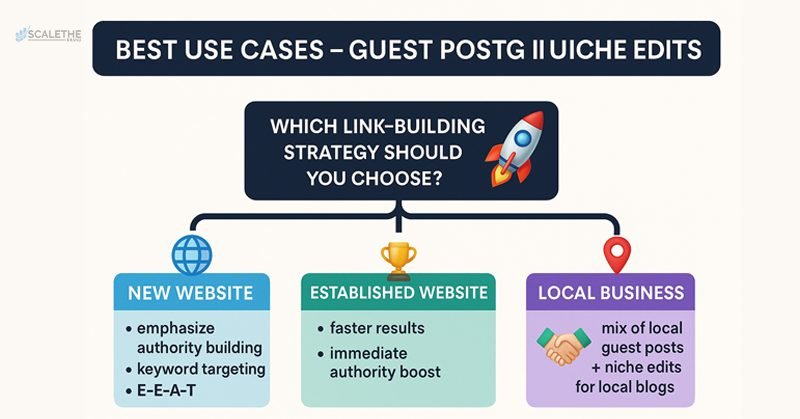
Best for New Websites
If you’re launching a brand-new website with low Domain Authority (DA) and no established backlinks, guest posting is the ideal starting point. It gives you full content control, letting you target primary keywords, optimize anchor text, and build E-E-A-T (Experience, Expertise, Authoritativeness, Trustworthiness) from the ground up. Publishing on niche-relevant, high-DA sites sends strong trust signals to Google, helping your domain get recognized in your industry faster.
Best for Established Websites
Websites with a solid content library and a moderate-to-high Domain Rating (DR) can gain quicker results with niche edits. By inserting links into indexed, high-ranking pages, you get an almost immediate link juice transfer to your target URLs. This is perfect for boosting link velocity without producing a ton of new content; an efficient way to scale for competitive search terms.
Best for Local SEO and Small Businesses
For local businesses and small brands, a hybrid link-building approach works best. Publish guest posts on local directories, community blogs, and niche-relevant websites to strengthen local authority and brand visibility. Then, complement these with niche edits from local news outlets, blogs, and resource pages to capture geo-targeted organic traffic. This combination improves both your Local SEO and broader search presence.
For local businesses and small brands with limited budgets, pairing these strategies with affordable SEO services for small businesses can help maximize results without overspending.
When to Combine Both for Maximum Authority
The best link-building techniques in 2025 combine specialty edits with guest blogging. Guest articles provide long-term ranking power, increase your content footprint, and develop thought leadership. Niche edits use reputable, well-established material to instantly gain authority. When combined, they increase link variety, boost SERP ranks, and build a more robust backlink profile, all of which lower the danger of depending too much on one strategy.
Advanced Link-Building Tactics Related to Guest Posts & Niche Edits
Broken Link Building
Broken link building is a smart, value-first way to earn backlinks while helping other site owners. The idea is simple: find dead outbound links on relevant websites and suggest your content as a replacement.
Use tools like Ahrefs, SEMrush, or the Check My Links Chrome extension to uncover broken links. Then, pitch the site owner with a polite, personalized email pointing out the issue and offering your indexed content as the perfect fix. This tactic pairs well with niche edits, as it often involves adding links to already ranking pages.
Press Mention Link Building
With press mention link building, you turn brand mentions into clickable backlinks. Set up monitoring with Google Alerts, Mention, or BuzzSumo to track unlinked references to your brand in news articles, blogs, or social posts.
When you find one, reach out to the publisher or journalist and request a link attribution. This works especially well for guest post authors who are regularly cited in industry publications, helping to turn mentions into authority links.
Resource Page Link Building
Resource page link building targets curated lists, “best tools” pages, or niche-specific resource hubs. Use Google search operators like:
intitle: resources "your keyword"
to find opportunities. Once identified, pitch your content, product, or tool for inclusion. Pairing this with guest posting can boost your topical relevance and improve your chances of being accepted, while also securing high-authority links.
Skyscraper Technique for Link Replacement
The Skyscraper Technique is all about building something better than what’s already out there. Start by finding high-performing content with many backlinks. Then create an improved, updated, and more in-depth version.
Next, run an outreach campaign targeting the sites linking to the original content, encouraging them to link to your content upgrade instead. This complements guest posting by positioning you as a subject matter expert and works with niche edits by replacing outdated links on high-authority pages with your improved resource.
Choosing the Right Service Provider
Metrics to Check (DA, DR, Traffic Source, Relevance)
Before investing in any guest posting or niche edit service, evaluate the quality of the target sites using proven SEO metrics:
▸ Domain Authority (DA): A Moz metric that estimates a domain’s potential to rank in search engines.
▸ Domain Rating (DR): An Ahrefs score measuring the overall strength of a site’s backlink profile.
▸ Traffic Source: Confirm the majority of traffic comes from your target country or niche to ensure relevancy.
▸ Topical Relevance: The site’s content should align with your industry; irrelevant backlinks can harm your rankings instead of helping.
Tools like Ahrefs, SEMrush, and Moz make it simple to verify these metrics before committing to a campaign.
Avoiding Low-Quality Link Builders & PBNs
▸ Not all link vendors play fair. Some rely on Private Blog Networks (PBNs), fake traffic, or irrelevant niche sites to deliver cheap but risky links.
▸ Watch for warning signs: identical site designs, repetitive anchor text patterns, and a backlink profile loaded with spammy outbound links (think casino, payday loans, or pharma).
▸ To stay safe, align your strategy with Google Webmaster Guidelines and steer clear of link schemes that could lead to penalties.
Transparency and Reporting
A trustworthy service provider should offer full visibility into the process:
▸ Share pre-approval lists of potential websites for your backlinks.
▸ Provide detailed placement reports with the live URL, DA/DR, and anchor text used.
▸ Offer a replacement guarantee if a link gets removed within an agreed period.
▸ Maintain clear, consistent communication from initial outreach to final link placement.
Real-World Case Studies
Fashion Brand Growth with Guest Posts
A mid-sized fashion e-commerce brand partnered with a skilled outreach agency to secure guest posts on top-tier lifestyle and fashion blogs, many with a Domain Authority (DA) above 60. Over a 6-month campaign, they landed 25 contextual backlinks pointing directly to their product category pages. The results were impressive:
▸ 37% increase in organic traffic
▸ 22% boost in conversions
These gains came from improved SERP visibility for high-competition keywords like “sustainable fashion” and “eco-friendly clothing.”On top of that, the brand scored press mentions in well-known fashion magazines, each linking back to their editorial content, further elevating their brand authority and online reputation.
Local Service Business Boost with Niche Edits
A roofing company in Austin, Texas, turned to niche edits to quickly dominate local SEO for searches like “roof repair Austin” and related service keywords.
By partnering with a provider who secured niche edits on already-indexed content, including locally relevant blog posts and home improvement resource pages, the company achieved a top 3 Google ranking for its primary keyword in just 5 weeks. The geo-targeted strategy paid off big:
▸ 61% increase in inbound calls
▸ A significant spike in Google Business Profile clicks and interactions
This campaign proved how resource page link building and niche edits can work hand-in-hand to deliver fast, measurable results for local businesses.
Google’s View on Link Building
Webmaster Guidelines and Link Schemes
According to Google’s Webmaster Guidelines, any backlink created with the intent to manipulate search rankings can be flagged as part of a link scheme. This includes:
▸ Buying or selling links
▸ Excessive link exchanges
▸ Automated link creation
However, both guest posting and niche edits remain safe and effective when approached the right way, meaning they’re placed on quality, relevant websites within editorially controlled content. The golden rule? Build links for user value first, and let PageRank follow naturally, instead of chasing purely algorithmic boosts.
White Hat vs Grey Hat vs Black Hat
Understanding these categories helps you choose strategies that protect rankings while still delivering growth.
▸ White Hat SEO: 100% aligned with Google’s rules, think guest posts on relevant sites, well-researched niche edit placements, and editorial links earned through genuine outreach.
▸ Grey Hat SEO: Operates in a riskier “middle zone”, for example, paying for niche edits on relevant sites without clear disclosure. Not always penalized, but risky if scaled aggressively.
▸ Black Hat SEO: Directly breaks the rules using PBNs, placing irrelevant backlinks, or inserting links into spun content.
How to Keep Your Links Safe from Penalties
Following these best practices keeps your link profile clean, natural, and penalty-proof. To protect your rankings and avoid Google penalties:
▸ Maintain topical relevance between the linking page and your target URL.
▸ Use anchor text diversity to prevent over-optimization signals.
▸ Check for organic traffic, not just high DA/DR scores.
▸ Avoid patterns that look manufactured, like multiple links from the same IP or network.
▸ Perform regular backlink audits with tools such as Ahrefs, SEMrush, or Google Search Console, and use the Disavow Tool for harmful links.
Conclusion of Niche Edits vs Guest Post
While specialty edits provide immediate SEO gains, guest posting establishes long-term authority. When combined, they provide a potent, well-rounded link-building approach. You may improve results, increase organic traffic, and fortify your backlink profile by combining the quickness of exploiting existing sites with the legitimacy of new, high-quality content. The wise decision in 2025 is to do both.
Frequently Asked Questions
Here are some answers to common questions
Which is more cost-effective, guest posting or niche edits?
Niche edits are generally cheaper since they don’t require new content creation, but guest posts can provide greater long-term value when targeted properly.
Which works faster for SEO rankings?
Niche edits often show results in weeks due to existing page authority, while guest posts typically take 2–6 months to fully impact rankings.
Can I use both strategies together?
Yes. Combining them improves link diversity and balances immediate ranking boosts with long-term authority building.
Which is better for local SEO?
Guest posts on local community blogs combined with niche edits from locally relevant websites deliver the strongest local search impact.
Are paid guest posts or niche edits safe?
They can be safe if the placements are relevant, on high-quality sites, and follow Google Webmaster Guidelines, and avoid spammy PBNs or irrelevant link placements.
How do I measure the Return On Investment (ROI) of my link-building campaign?
Track changes in organic traffic, keyword rankings, referral traffic, and conversions using tools like Google Analytics, Google Search Console, and Ahrefs.