In today’s digital world, the ability to write a good article is more important than ever. Whether you’re a student writing an assignment, a blogger trying to grow your audience, a marketer promoting a brand, or a journalist reporting the news, article writing is a powerful skill.
With the help of articles, we may share ideas, inform readers, influence views, and even boost sales. They are among the most widely used and effective kinds of textual communication in blogs, journals, newspapers, and online platforms.
But writing a good article requires more than just putting words on paper. When an essay is strong, it is understandable, engaging, and instructive. It immediately grabs the reader’s attention, provides useful information in a systematic approach, and leaves an impression. This book will show you how to become an expert at every step of the article writing process, from choosing a topic to polishing your final piece.
What is Article Writing?
Article writing means creating written content that gives information, shares opinions, or explains something in detail. Articles are usually published in newspapers, magazines, or online platforms. The goal is to make the reader learn something new or understand a topic better. Think of an article as a conversation with your reader, where you explain things in a friendly and easy way.
Why Article Writing Matters Today
In an age of information overload and short attention spans, writing meaningful articles is more valuable than ever. Whether you’re a business, blogger, educator, or freelancer:
- Articles boost visibility online through SEO (Do you know what is SEO?)
- Establish authority and trust with readers
- Help solve problems or share unique insights
- Drive leads, traffic, or even revenue
Types of Articles
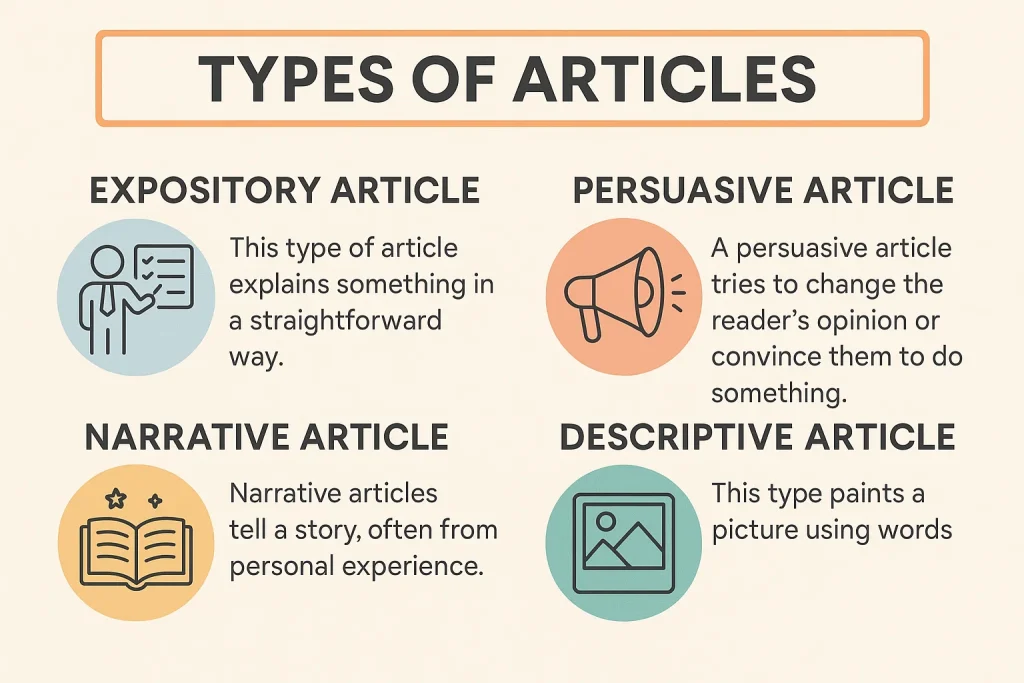
Depending on your intent and audience, articles typically fall into four main categories:
1. Expository Article
This type of article explains something in a very straightforward way. It gives facts, steps, or instructions without adding personal opinions. For example, “How to Open a Bank Account” or “What Is Climate Change?” You simply guide the reader by sharing useful information clearly. It’s like being a teacher who sticks to the facts.
2. Persuasive Article
A persuasive article tries to change the reader’s opinion or convince them to do something. For example, an article about “Why Everyone Should Drink More Water” will use reasons, facts, and emotions to persuade. It’s like a friendly debate where you’re trying to prove your point. These articles often include strong statements and examples.
3. Narrative Article
Narrative articles tell a story, often from personal experience. It could be “My First Trip to the Mountains” or “How I Overcame Exam Stress.” The goal is to connect emotionally with the reader and take them on a journey. It’s like sitting around a campfire and sharing a meaningful story.
4. Descriptive Article
This type paints a picture using words. It focuses on describing places, people, feelings, or events in great detail. For example, “A Rainy Evening in Milton” would describe the sound of rain, the smell of wet streets, and the mood of the city. It’s like giving your reader a ticket to visualize what you saw or felt.
Article vs Blog vs Journal: What’s the Difference?
Let’s take a quick look at the key differences between an article, a blog, and a journal to understand when and how each is used.
| Feature | Article | Blog | Journal |
|---|---|---|---|
| Tone | Formal to semi-formal | Conversational or personal | Academic and technical |
| Purpose | Inform, educate, persuade | Share experiences or insights | Present original research or scholarly work |
| Structure | Title, intro, body, conclusion | Flexible, often uses storytelling | Rigid: Abstract, Methods, Results, Discussion |
| Audience | General public or niche readers | Followers, casual readers | Experts, scholars, researchers |
| Source Usage | Backed by facts, often cites sources | May cite or be opinion-based | Strict citation and referencing are required |
Planning Before You Write
Before you start writing a single sentence, proper planning is crucial. Great articles aren’t created by accident; they’re crafted with intention, focus, and clarity.
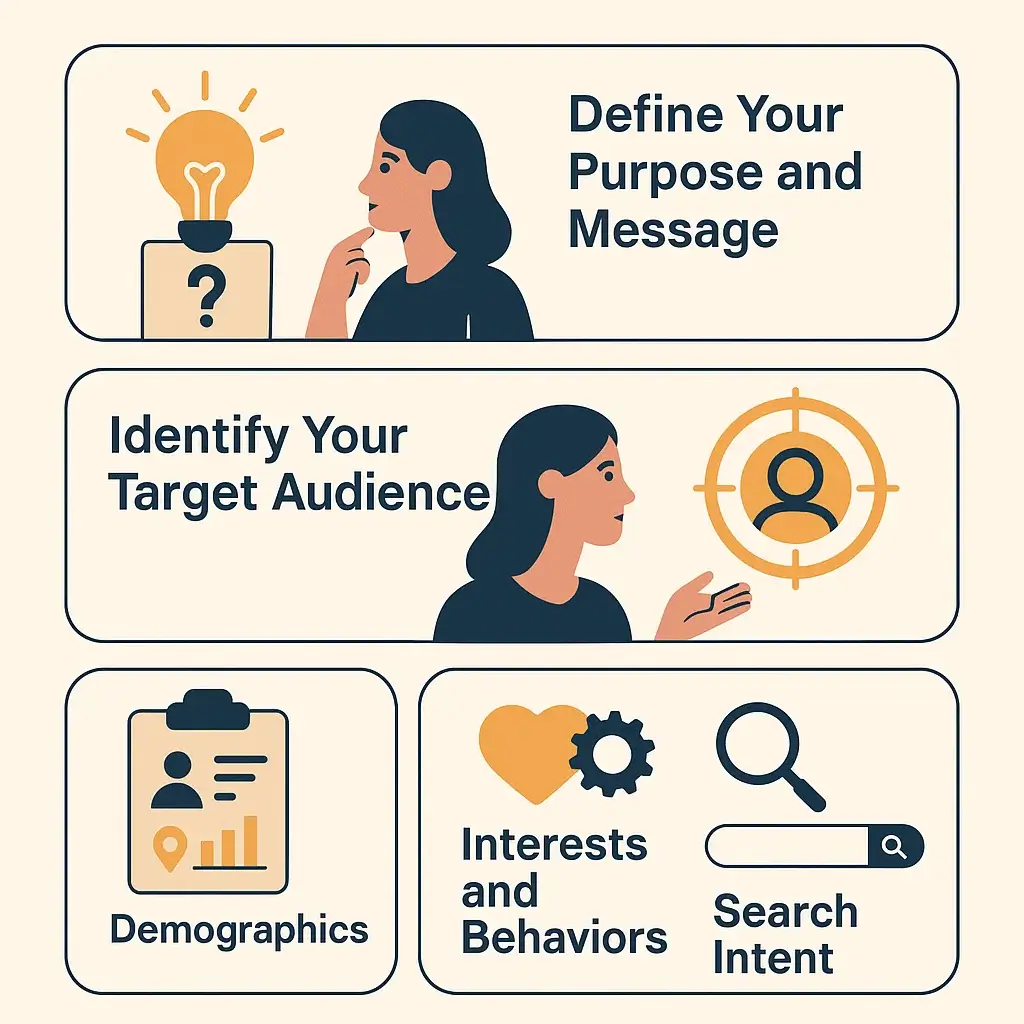
Define Your Purpose and Message
Ask yourself: Why am I writing this article? Your purpose could be to:
- Inform or educate (e.g., tutorials or guides)
- Promote a product or service
- Share an opinion or raise awareness
- Establish expertise in a niche
Once the purpose is clear, clarify your core message, the one thing you want your readers to take away. Everything in the article should revolve around that message.
Identify Your Target Audience
Imagine you’re talking to one person while writing. Who is that person? Knowing your audience helps you choose the right words, tone, and examples.
For example, if you’re writing for teenagers, your style will be different than if you’re writing for business professionals.
Demographics
Demographics mean basic facts about your audience, like age, gender, location, or education level. These details help you shape your writing.
For example, writing for startup founders in the U.S. (age 30–45) is very different from writing for high school students in Europe.
Interests and Behaviors
This means thinking about what your audience likes to do and how they spend their time. Do they enjoy fitness, travel, or technology? Are they beginners or already experienced in the topic?
For example, if your readers love cooking, a recipe article with helpful tips will grab their attention.
Search Intent
Search intent means what the reader is really looking for when they type something into Google. Are they looking for quick answers, step-by-step guides, or honest product reviews?
For example, someone searching “best laptops under $500” wants recommendations, not tech history.
How to Structure Your Article Like a Pro
Writing a great article doesn’t start with typing; it starts with research and planning. Whether you’re creating content for your blog, a brand, or SEO purposes, having a proven structure and a research-backed process is key to standing out. Here’s how to do it step-by-step, just like the pros (and how I do it, too).
Research First, Write Later
Before writing anything, I start by analyzing my competitors. After selecting the main keyword for the topic, I study what other top-ranking articles have covered, and more importantly, what they’ve missed. This helps me identify content gaps and unique angles.
Then, I take things deeper by using NLP (Natural Language Processing) analysis to extract important entities and phrases from those articles. These entities are like topic-related keywords and themes that Google understands and values.
To refine my keyword strategy, I use the Keywords Everywhere tool, which gives me real-time data on search volume, CPC, and keyword trends. My goal? Prioritize high-volume, relevant keywords and naturally integrate them into the content.
Article Writing Format
Every well-written article follows a format that’s easy to scan and delivers value from start to finish.
Title / Headline
Your headline is your first impression. It should be clear, catchy, and keyword-rich. Instead of “SEO Tips,” try something like “7 Actionable SEO Tips to Boost Your Google Rankings in 2025.” This not only grabs attention but also signals to search engines what your article is about.
Introduction: Pain, Promise, Preview
My intros follow a simple but powerful formula:
- Pain Point: Address the reader’s problem or question.
- Solution: Hint at the value the article offers.
- Preview: Summarize what’s coming up.
Example: Struggling to rank your content in Google despite writing regularly? You’re not alone. In this guide, you’ll learn a step-by-step method to write SEO-optimized articles that perform, starting with keyword research and ending with strategic formatting.
Body: Organized, Helpful, and Scannable
The body of the article is where the real value lives. Here’s how I structure it:
- Short paragraphs (2–3 lines max)
- Clear subheadings for each section
- Bullet points and numbered lists for key takeaways
- Infographics, visuals, or tables for visual learners
- Real-life examples or data to support points
And most importantly, I write like I’m talking to a friend, simple, direct, and helpful.
Conclusion: Final Thoughts + CT
The conclusion should wrap up the main idea and gently push the reader to take action. I like to:
- Recap the key point(s)
- Offer encouragement or the next step
- Add a CTA (Call to Action)
Example: Now that you know how to plan and structure a high-quality article, why not pick a trending topic and start applying what you’ve learned?”
FAQs & Bonus Tips
To provide even more value and capture additional SEO traffic, I add an FAQ section at the end. These answer common questions related to the topic, like:
- What tools can help me write better articles?
- How long should an article be?
- Do I need to be a professional writer to write articles?
You can even pull FAQs directly from Google’s “People Also Ask” section or from your audience’s real questions.
How to Optimize Your Article
Writing a great article doesn’t start with typing; it starts with research and planning. Whether you’re creating content for your blog, a brand, or SEO purposes, having a proven structure and a research-backed process is key to standing out. Here’s how to do it step-by-step, just like the pros (and how I do it, too).
SEO Best Practices
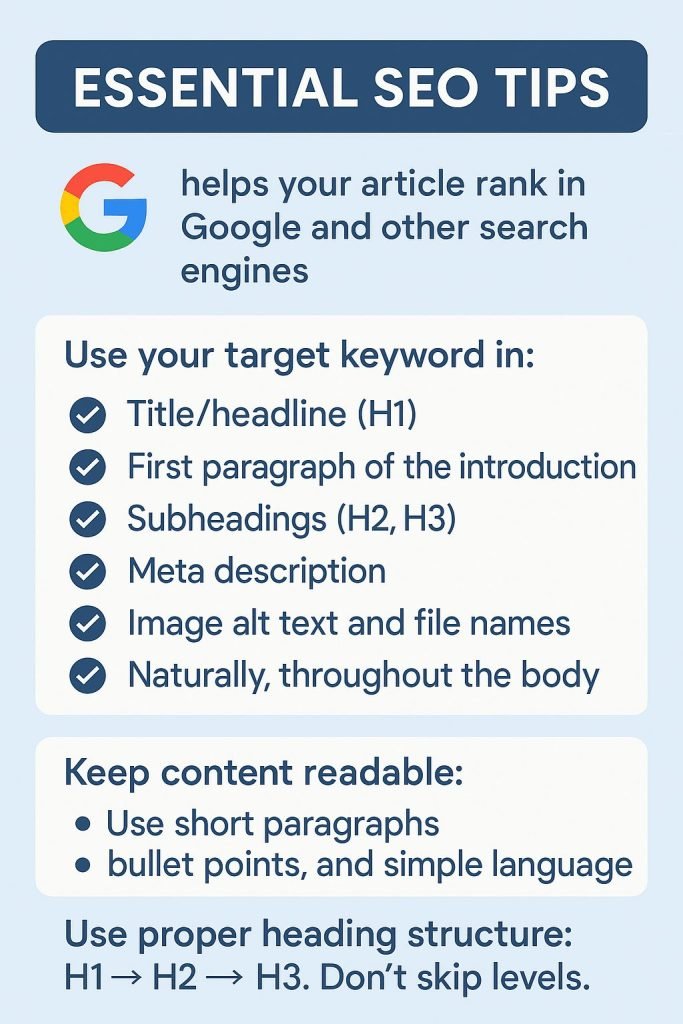
Search Engine Optimization (SEO) helps your article rank in Google and other search engines. Here are the essentials:
- Use your target keyword in:
- Title/headline (H1)
- First paragraph of the introduction
- Subheadings (H2, H3)
- Meta description
- Image alt text and file names
- Naturally, throughout the body
- Keep content readable: Use short paragraphs, bullet points, and simple language.
- Use proper heading structure: H1 → H2 → H3. Don’t skip levels.
Keyword Research Tools
Before you even start writing, you should know what people are searching for. The following are top tools to help you do keyword research and discover valuable phrases related to your topic:
- SEMRush (Keyword Magic Tool for volume, intent, and difficulty)
- Google Keyword Planner (Free tool for discovering related keyword ideas)
- Answer the Public (Great for uncovering common questions)
- Ubersuggest (Simple and effective for keyword ideas)
When using these tools, try to find keywords with high search volume but low competition. For example, if you’re writing for business owners, keywords like “Affordable SEO services for small businesses” can be very effective and niche-specific.
Meta Description and URLs
Both play a critical role in click-through rate (CTR) and SEO.
Meta Description
- 150–160 characters
- Summarize the article’s value
- Include your main keyword
- Make it attractive (but not clickbait)
URL Structure
- Short, clean, and keyword-rich
- Use: example.com/write-seo-articles
- Avoid: example.com/blog/245723?type=writing123
Alt Text and Image Optimization
Images should enhance the article and support SEO.
- Use descriptive filenames (e.g., article-structure-example.png)
- Add alt text describing the image (with a keyword if relevant)
- Compress images for faster page load speed
Internal Linking Strategy
Internal links keep readers on your site longer and help search engines understand your content.
- Link to related articles or pages on your website
- Use descriptive anchor text (e.g., “writing checklist,” not just “click here”)
- Don’t overdo it, link only where it’s helpful
Editing and Proofreading
Your first draft is never your final draft. Even the best-written article can benefit from a good polish. Editing and proofreading ensure your content is clear, concise, error-free, and reader-ready. It’s also your last chance to make sure your article reflects your voice and purpose.
Time-Saving Tools to Polish Your Writing
Technology can make your editing process faster and more effective. Here are a few must-use tools:
- Grammarly checks grammar, spelling, punctuation, and style suggestions.
- Hemingway Editor helps make your writing more concise and readable by flagging passive voice and complex sentences.
- Google Docs is great for writing, formatting, and collaborating with others in real time.
- Notion or Trello is useful for planning content calendars, outlines, and managing writing tasks.
- ChatGPT or AI Writing Assistants can help brainstorm ideas, create outlines, or even suggest edits.
- CoSchedule Headline Analyzer evaluates your article titles for clarity, emotional impact, and SEO strength.
- Yoast SEO (WordPress plugin) guides you in optimizing your content for search engines.
- Quillbot is a rephrasing tool that helps improve sentence structure and avoid repetition.
How to Publish & Promote Your Article
Once your article is polished and optimized, don’t stop there; publishing and promotion are where your hard work pays off. Whether you’re building a writing career, attracting clients, or growing an audience, this step determines how far your content reaches.
Freelance vs Employment Paths
When it comes to writing as a career, you have two main options: freelance or full-time employment.
- Freelance writing gives you the freedom to choose your clients, set your rates, and work from anywhere, even your couch! However, it also implies that you must find work and effectively manage your time.
- On the other hand, working as a Staff writer (employed by a company) gives you a steady paycheck, regular hours, and maybe even health benefits.
Building a Writing Portfolio
Similar to a CV, your writing portfolio highlights your abilities. Start by collecting your best articles, blog posts, or even social media content that shows off your skills. If you’re just starting and don’t have published work yet, don’t worry! You should write sample articles on subjects you are passionate about and add them to your portfolio. Use free websites like WordPress, Medium, or even Google Drive to display your work in a clean and professional way.
Where to Submit Your Articles
Many websites and magazines accept articles from new writers. For example, you can submit to platforms like Medium, Vocal Media, or even local newspapers and blogs. Some websites pay for good articles, while others offer you exposure (so more people see your name and work). Always read the submission guidelines before sending your article; it’s like reading the rules before entering a contest.
Promoting Your Content Online
Once your article is published, don’t just sit back; share it! Post it on your social media like Facebook, Instagram, LinkedIn, or Twitter (now called X) to reach more people. You can also join writing groups or forums and share your work there. Think of your content as a little plant; it needs sunlight (promotion) to grow.
How to Grow as a Content Writer
Writing your first article is an achievement. But to turn content writing into a lasting career or personal brand, you need to keep growing in skill, strategy, and mindset.
Choosing and Growing in a Niche
A “niche” is a certain area or topic that you decide to concentrate on, such as parenting, technology, travel, or health. Selecting a niche enables you to become an expert in that field, and customers respect experts. For example, if you love fitness, you can write blogs about workouts, healthy eating, or gym tips. As you grow, you’ll learn more about your topic, and writing will feel easier and more natural.
Resources for Writers
There are so many free and helpful tools out there to make writing easier. Websites like Grammarly help you fix grammar mistakes, while Hemingway Editor shows you how to write clearly. You can also learn new things by reading blogs, watching YouTube tutorials, or taking short online courses on platforms like Coursera or Skillshare. Follow writers you admire on social media to see how they write and what they share.
Staying Inspired and Original
Every writer hits a block sometimes; it’s normal. To stay inspired, read books, watch movies, go outside, or have deep conversations with friends. Inspiration often comes from everyday life. Try to write in your voice instead of copying others; your unique point of view is what makes your content special.
Feedback, Peer Review & Revisions
Feedback is essential to our growth, so don’t be scared of it. Ask a friend, fellow writer, or mentor to read your work and give honest suggestions. Sometimes they catch mistakes you didn’t notice, or they help you make your message clearer. Rewriting might feel boring, but it’s actually where the magic happens; good writing becomes great in the editing stage.
Final Thoughts of How to write an article
Writing a fantastic essay doesn’t have to be difficult or intimidating. Choose a subject that interests you, make a strategy for what you want to say, and then write as if you were speaking to a friend. Make your content easy to grasp by using straightforward language, genuine examples, and a clear structure. Keep in mind that even the most skilled writers don’t always get it right the first time.
Editing, receiving comments, and reworking are crucial because of this. Continue to learn from each article you create and gladly share your effort. Over time, both your abilities and self-assurance will grow. So pick up your pen (or keyboard) and begin writing. I hope you now have a thorough understanding of how to compose an article.
Frequently Asked Questions
Here are some answers to common questions
How do I start writing an article?
You can start by choosing a clear topic and understanding who your audience is. Then make a simple outline, write a rough draft, and improve it through editing.
What makes a good article?
A good article is easy to read, focused on one main idea, and provides value to the reader. It uses short paragraphs, subheadings, and examples to keep readers interested.
Do I need to be a professional writer to write articles?
Not at all! Anyone can write articles with a little practice. You should focus on being clear, helpful, and real. Your unique voice is what makes it special.
How long should an article be?
It depends on the topic and purpose. Most web articles are between 1000–1,800 words. Just make sure you cover the topic well without dragging it out.
What tools can help me write better articles?
Some useful tools to help you write better articles include Grammarly, Hemingway Editor, Google Docs, Notion, Trello, ChatGPT, CoSchedule Headline Analyzer, Yoast SEO, and Quillbot.
Where can I publish my articles?
You can post on your blog, Medium, LinkedIn, or submit guest posts to websites in your niche. You can also write for online magazines or content platforms.