In today’s digital world, businesses, researchers, and everyday users face a common challenge: making sense of an overwhelming amount of information. Traditional software and search engines can only go so far; they follow rigid rules and often fail to understand the nuance of human language. This creates frustration when people need quick, accurate, and context-aware answers, whether it’s summarizing reports, writing code, or improving customer service.
Large Language Models (LLMs) and sophisticated AI systems like OpenAI’s GPT-4, Google Gemini, Anthropic’s Claude, and Meta’s LLaMA 2 hold the key to the answer. These models fuel everything from chatbots and content production to healthcare analytics and financial automation because they can comprehend, produce, and modify human-like language at scale. LLMs bridge the gap between machine intelligence and human communication by fusing deep learning with large datasets.
We’ll go over all you need to know about LLMs, including their definition, operation, applications, best practices, benefits, drawbacks, and potential future developments. Additionally, we’ll go over how companies and developers may use platforms like Google Vertex AI, IBM Watsonx, Cloudflare Workers AI, and Microsoft Azure OpenAI to build using LLMs. This tutorial will help you comprehend the potential and power of LLMs, regardless of whether you are a developer, business executive, or tech enthusiast.
Introduction to Large Language Models (LLMs)
Lets discuss what is LLMS and how it evluated:
What is a Language Model?
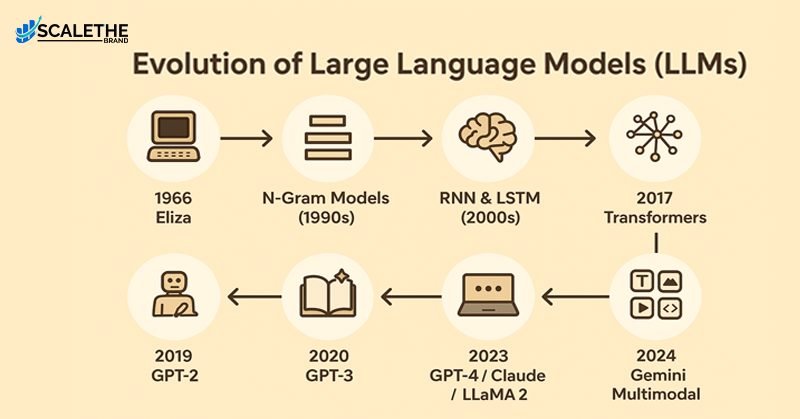
An artificial intelligence (AI) system that can comprehend and produce human language is called a language model. Fundamentally, a language model functions by forecasting the subsequent word in a series depending on the preceding words. Only extremely simple text predictions could be handled by early examples like Eliza (1966 at MIT) and statistical models like N-grams. More sophisticated methods, like as long short-term memory (LSTM) models and recurrent neural networks (RNNs), were created over time to capture context in longer text sequences.
Language models now serve as the foundation for many contemporary natural language processing (NLP) applications, including voice assistants and search engine autocomplete.
What is a Large Language Model (LLM)?
A Large Language Model (LLM) is a more powerful version of a language model, built using deep learning techniques and trained on massive datasets containing billions of words. The key innovation behind LLMs is the transformer architecture, introduced by Google in 2017, which uses a mechanism called self-attention to understand relationships between words in context. LLMs are designed with billions (sometimes even trillions of parameters) that allow them to generate human-like text, translate languages, summarize content, write code, and much more.
Why Are Large Language Models Important?
Large language models are important because they bridge the gap between human communication and machine intelligence. Unlike traditional software that follows rigid instructions, LLMs can understand natural language and respond with context-aware answers. For businesses, LLMs unlock opportunities in customer service chatbots, automated content creation, knowledge discovery, and even healthcare applications.
In fact, many companies now use LLMs to improve digital marketing, content writing, and even Affordable SEO services for small businesses,making advanced AI tools accessible to startups and local brands. For developers, models like GPT-4, Claude 2, and Google’s Gemini can generate or debug code, saving hours of manual work. Their importance also lies in their versatility: one model can perform multiple tasks, from sentiment analysis to translation, without requiring separate systems.
Evolution of LLMs and Generative AI
The journey of LLMs mirrors the rapid progress of AI. Early language models were small and limited, but the breakthrough came in 2017 with the introduction of the transformer model. This architecture made it possible to train much larger systems efficiently, giving rise to Generative Pre-trained Transformer (GPT) models.
- 2018–2020: GPT-2 and GPT-3 demonstrated how scaling data and parameters led to more fluent text generation.
- 2022–2023: GPT-3.5, GPT-4, and competitors like Claude and LLaMA 2 brought LLMs into the mainstream through tools like ChatGPT.
- 2024 onward: The rise of multimodal LLMs such as Google Gemini, which can understand text, images, and video, shows how generative AI is evolving beyond text.
This evolution highlights a clear trend: larger, more specialized, and multimodal LLMs are shaping the future of AI, transforming how humans interact with technology in work, research, and daily life.
How Large Language Models Work
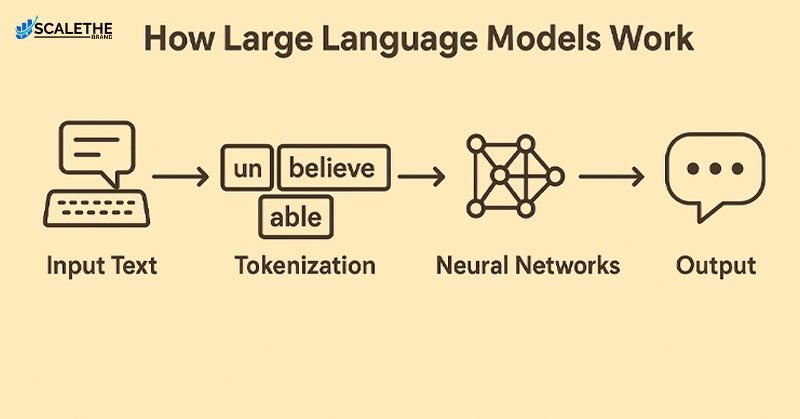
Let’s understand how large language models work:
Machine Learning and Deep Learning Basics
Machine learning (ML), the capacity of a computer system to discover patterns from data without explicit programming, is the cornerstone of all large language models (LLMs). Deep learning, which processes enormous volumes of text using multi-layered neural networks, is a crucial method in machine learning.
LLMs can now comprehend semantics, syntax, and context in addition to basic word prediction because to deep learning. For instance, when you pose a question to ChatGPT (powered by GPT-4), the underlying deep learning algorithms examine patterns in billions of texts to produce a logical and context-aware response.
Neural Networks in LLMs
LLMs rely on artificial neural networks, which are inspired by the way the human brain processes information. A neural network is made up of layers of interconnected nodes (or “neurons”). Each node transforms input data into outputs that feed into the next layer, gradually building a rich understanding of the text.
In modern LLMs like Claude 2 or LLaMA 2, these networks contain billions or even trillions of parameters, giving them the ability to capture subtle patterns in language, from idioms and metaphors to technical jargon.
Transformer Architecture
The real breakthrough behind LLMs came with the transformer architecture, introduced by Google in 2017. Unlike earlier models (such as RNNs and LSTMs) that processed text word by word, transformers can analyze entire sequences in parallel, making them faster and more efficient.
Transformers allow models like Google Gemini and GPT-4 to handle long-form context, such as multi-paragraph essays or even entire books, and generate responses that stay coherent throughout.
Self-Attention Mechanism
At the heart of transformers lies the self-attention mechanism. This technique allows the model to determine which words in a sentence are most relevant to each other.
For example, in the sentence “The dog chased the cat because it was hungry,” the model must understand that “it” refers to the dog, not the cat. Self-attention helps LLMs like ChatGPT and Claude resolve such ambiguities, making them capable of context-aware reasoning.
Parameters and Tokens
Two key terms often come up in discussions about LLMs: parameters and tokens.
- Parameters are the internal variables that the model learns during training. Modern LLMs like GPT-4 or LLaMA 2 have hundreds of billions of parameters, which allow them to represent highly complex patterns in human language.
- Tokens are the chunks of text (words, subwords, or characters) that an LLM processes. For instance, the word “unbelievable” might be broken into smaller tokens like “un” + “believe” + “able.” The ability to handle millions of tokens enables advanced models like Claude 2 to process and respond to entire books or lengthy technical documents.
Training Methods
Training an LLM involves different approaches:
- Zero-Shot Learning: The model can handle a task without specific training, relying only on general patterns it has seen in data (e.g., GPT-3 answering trivia questions).
- Few-Shot Learning: The model improves its performance when given a few examples in the prompt (e.g., showing how to classify sentiment before asking for new predictions).
- Fine-Tuning: Developers retrain the model on a domain-specific dataset (like medical records or legal texts) to specialize it for that field. For example, OpenAI Codex is a fine-tuned version of GPT-3 designed specifically for code generation.
Reinforcement Learning with Human Feedback (RLHF)
One of the most important advancements in making LLMs safer and more useful is Reinforcement Learning with Human Feedback (RLHF). This process involves training a model not just on text data but also on human preferences. Here’s how it works:
- The LLM generates multiple possible answers.
- Human reviewers rank those answers.
- The model learns to prioritize the responses humans prefer.
This technique is what makes models like ChatGPT (GPT-4), Claude, and Gemini better at following instructions, avoiding harmful outputs, and sounding more natural in conversations.
Applications of Large Language Models (LLMs)
The applications of large language models are:
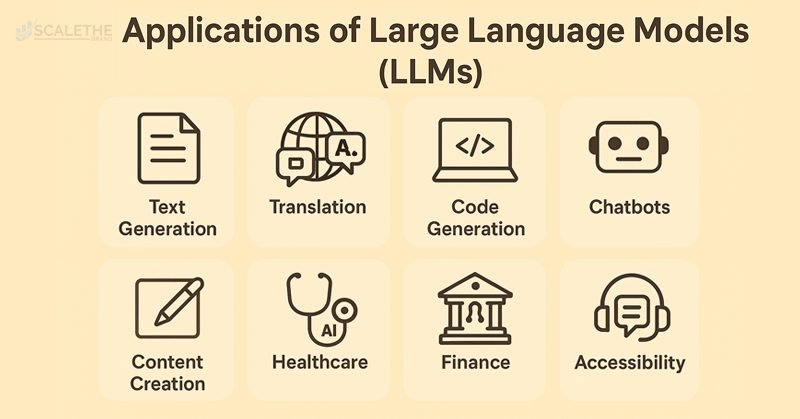
1. Text Generation & Summarization
One of the most common uses of large language models is text generation. Tools like ChatGPT (powered by GPT-4) or Claude 2 can produce essays, stories, blog posts, or even technical reports within seconds. Beyond generating text, they can also summarize long documents, condense news articles, or create quick overviews of research papers.
2. Language Translation
LLMs excel at language translation because they are trained on multilingual datasets. Unlike traditional translation software, models like Google Gemini and Meta’s LLaMA 2 can capture the context and nuance of a sentence, making translations more natural. For example, they can translate idioms or cultural expressions that older rule-based systems often struggled with.
3. Code Generation & Debugging
Modern LLMs are not just skilled with human language; they can also understand and generate programming code. OpenAI Codex, which powers GitHub Copilot, and models like GPT-4 can write Python, JavaScript, or SQL functions from simple natural language prompts. They can also debug code, suggest optimizations, and even explain errors to developers.
4. Content Creation (Copywriting & Rewriting)
For marketing and media, LLMs are powerful tools for copywriting and rewriting. Brands use them to draft ad copy, social media posts, email campaigns, or product descriptions. One of the hottest debates in digital marketing is Does AI content work for SEO? and while search engines evolve, LLMs are already being used to generate optimized content. Models like Claude and Cohere Command can also rewrite existing text for better clarity, tone, or SEO optimization.
5. Knowledge Base Answering (KI-NLP)
Another key application is Knowledge-Intensive Natural Language Processing (KI-NLP). LLMs can sift through large databases or archives to answer specific questions. For example, AI21 Labs’ Jurassic-1 or Claude 2 can process thousands of pages of technical documentation and deliver concise, accurate responses. This capability overlaps with how search engines work, indexing massive data sets to provide relevant results. LLMs take it further by interpreting queries with human-like reasoning.”
6. Sentiment Analysis & Classification
LLMs are also effective at text classification and sentiment analysis. Businesses use them to analyze customer feedback, product reviews, or social media conversations to determine whether users feel positively or negatively about a brand.
7. Conversational AI (Chatbots & Virtual Assistants)
One of the most visible applications of LLMs is in conversational AI. Tools like ChatGPT, Google Bard (Gemini), and IBM Watsonx Assistant power chatbots and virtual assistants that can answer customer questions, schedule tasks, or provide product support.
8. Industry Applications (Healthcare, Finance, Customer Service, Research, Accessibility)
LLMs are transforming entire industries:
- Healthcare: Analyzing patient records, summarizing medical research, and assisting with clinical documentation.
- Finance: Automating financial reporting, detecting fraud patterns, and analyzing market sentiment.
- Customer Service: Powering 24/7 chatbots, reducing wait times, and improving first-contact resolution.
- Research & Academia: Summarizing scientific papers, suggesting hypotheses, and aiding knowledge discovery.
- Accessibility: Supporting people with disabilities by generating text-to-speech, simplifying complex documents, and enabling real-time translations.
From GPT-4 in virtual assistants to Claude in knowledge management and Gemini in multilingual tasks, LLMs are becoming central to how industries work smarter and serve users better.
Examples of Large Language Models (LLMs)
The field of large language models has grown rapidly, with major tech companies and research labs building their own versions of generative AI. Below are some of the most recognized and widely used LLMs today.
- OpenAI
- Meta (Facebook)
- Claude (Anthropic)
- AI21 Labs
- Cohere
- IBM
- Falcon 40B
- Ernie (Baidu)
- LightOn Paradigm
Advantages of Large Language Models (LLMs)
The advantages of large language models are:
1. Extensibility & Adaptability
One of the biggest advantages of large language models is their ability to adapt to different tasks. Instead of training a new model from scratch for each problem, developers can build on top of an existing LLM. For example, OpenAI’s GPT-4 can be fine-tuned for customer support, legal document analysis, or creative writing. This extensibility makes LLMs highly versatile and cost-effective. For marketers, this adaptability means AI can even assist with tasks like how to write an article optimized for both readers and search engines.”
2. Performance & Accuracy
Modern LLMs deliver state-of-the-art performance in natural language processing tasks. They can summarize, translate, classify, and generate text with remarkable accuracy. For instance, Claude 2 can handle inputs up to 100K tokens, allowing it to summarize entire research papers while staying contextually accurate.
3. Multimodal Capabilities
Earlier LLMs focused only on text, but the latest generation is multimodal, meaning they can handle multiple types of input. GPT-4 introduced text-plus-image processing, while Google Gemini goes even further by working with text, images, video, and code. These multimodal LLMs open up new applications: describing images for accessibility, generating captions for videos, or even analyzing charts and graphs.
4. Scalability & Flexibility
LLMs are designed to scale both up and down depending on the use case. Enterprise platforms like IBM Watsonx Granite models can be integrated into large-scale enterprise systems, while lightweight open-source models such as LLaMA 2 or Falcon 40B allow smaller organizations to benefit from generative AI without huge infrastructure costs.
5. Efficiency in Automation
LLMs shine in automating repetitive and time-consuming tasks. In customer service, they power chatbots that can resolve common queries instantly. In research, they help summarize hundreds of articles, freeing experts to focus on analysis. In programming, models like Codex and GitHub Copilot automate boilerplate code generation, speeding up development cycles.
Challenges and Limitations of Large Language Models (LLMs)
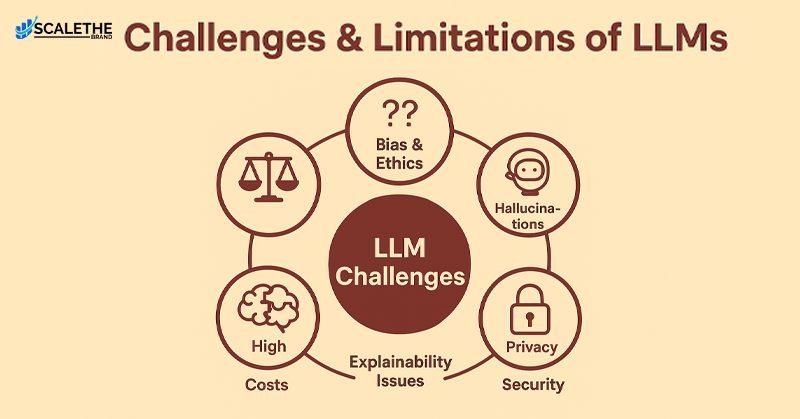
While large language models like GPT-4, Claude 2, Google Gemini, and LLaMA 2 are powerful, they are not without their weaknesses. Understanding these challenges is critical for businesses, developers, and users who rely on generative AI in sensitive or large-scale applications.
1. Bias & Ethical Concerns
LLMs learn from massive datasets collected from the internet. Since online text often contains social, cultural, and political biases, models can unintentionally reproduce or amplify these patterns. For example, GPT-4 or Gemini may generate answers that reflect gender, racial, or ideological biases present in training data. This raises serious ethical concerns.
2. Hallucinations & Incorrect Outputs
One of the most widely discussed issues in LLMs is hallucination, when the model generates confident but factually incorrect answers. For instance, a chatbot might invent a citation or provide a wrong medical explanation if it doesn’t have the right data.
3. Data Privacy & Security Risks
Another major challenge is data privacy. Since LLMs are trained on enormous datasets, they may unintentionally memorize sensitive information. If a user pastes confidential data into a chatbot like ChatGPT, there’s a risk that it could be stored or influence future outputs. In enterprise settings, this creates compliance and security risks.
4. High Development & Operational Costs
Training and running large models like LLaMA 2, GPT-4, or Falcon 40B requires massive computational power and specialized hardware such as GPUs and TPUs. The costs can run into millions of dollars, making LLMs difficult for smaller organizations to build or maintain. Even after deployment, the operational costs, such as cloud hosting, fine-tuning, and scaling, remain high.
5. Complexity & Explainability Issues
With billions or trillions of parameters, models like Gemini and GPT-4 can make highly accurate predictions but cannot always provide transparency into their reasoning. This lack of explainability is a challenge in regulated industries like finance, healthcare, and law, where accountability is critical.
Future of Large Language Models (LLMs)
The future of large language models (LLMs) is both exciting and transformative. With continuous research and rapid innovation from leaders like OpenAI, Google DeepMind, Meta, Anthropic, and IBM, the next generation of generative AI promises to be smarter, safer, and more useful across industries.
1. Increased Capabilities & Smarter Models
Future LLMs will continue to grow in capabilities and reasoning power. Models like GPT-4 and Claude 2 already outperform earlier versions in logic, coding, and summarization, but upcoming iterations will likely reduce errors (hallucinations), handle longer contexts, and provide more accurate, reliable answers. LLMs with the ability to perform real-time fact-checking.
2. Audiovisual & Multimodal Training
The next era of LLMs won’t just focus on text. Multimodal AI combining text, images, audio, and video is already here with Google Gemini and GPT-4’s image-processing abilities. Future models may analyze videos, speech, and even sensor data, making them useful for autonomous systems, healthcare diagnostics, and immersive learning environments.
3. Workplace Transformation
LLMs are expected to reshape the workplace much like industrial automation did decades ago. In the future, AI copilots will handle repetitive office tasks, generate reports, analyze spreadsheets, and provide decision support. Tools like GitHub Copilot (powered by Codex) are early examples, but we’ll see similar copilots in finance, law, medicine, and education.
4. Improved Conversational AI
Conversational AI is set to get even more natural and intuitive. Today’s chatbots, like ChatGPT, Claude 2, and Gemini, already handle complex queries, but future models will have emotional intelligence, better memory of past interactions, and the ability to maintain long-term personalized conversations.
5. Domain-Specific Retrieval-Augmented LLMs
General-purpose models like GPT-4 are impressive, but the future lies in domain-specific LLMs tailored to specialized fields. For example, healthcare LLMs trained on medical datasets could provide reliable clinical support, while legal-focused models could assist lawyers with case analysis.
6. Retrieval-Augmented LLMs
Another important trend is Retrieval-Augmented Generation (RAG), used in projects like Google’s Realm, which allows models to search live databases while generating answers. This will make future LLMs more accurate, up-to-date, and fact-driven.
7. Governance & Responsible AI
As LLMs grow more powerful, the need for AI governance, safety, and ethical oversight becomes urgent. Governments, corporations, and research institutions are already setting guidelines to ensure AI is trustworthy, transparent, and secure. In the future, responsible AI frameworks will be as important as the models themselves.
How to Build with Large Language Models (LLMs)
Building with large language models has become more accessible than ever. Thanks to a wide range of developer platforms, APIs, and fine-tuning techniques, businesses and developers can now integrate LLM-powered solutions into apps, chatbots, research tools, and enterprise systems.
Developer Tools & Platforms
Modern LLMs are supported by robust ecosystems that provide the infrastructure needed to train, deploy, and integrate models. These platforms make it easier for developers to experiment, prototype, and scale generative AI applications without starting from scratch.
Cloudflare Workers AI
Cloudflare Workers AI is designed for developers who want to run LLM applications at the edge, close to their users. Combined with Vectorize (Cloudflare’s vector database) and R2 object storage, it enables fast and scalable deployment of custom AI solutions without heavy infrastructure costs.
Google Vertex AI
Google Vertex AI offers developers access to Google’s foundation models, including Gemini, a multimodal LLM capable of handling text, images, and video. Vertex AI offers tools for training, fine-tuning, and deploying custom models, as well as integrations with Google Cloud services. Developers can quickly build retrieval-augmented applications, document summarizers, and intelligent search systems on top of Vertex AI.
IBM Watsonx
IBM Watsonx is an enterprise-grade AI platform that includes the Granite model series. With a strong focus on responsible AI, governance, and transparency, Watsonx is built for industries like finance, healthcare, and government, where compliance is critical. Developers can use Watsonx Assistant and Watsonx Orchestrate to build conversational AI, workflow automation, and knowledge management tools powered by LLMs.
Microsoft Azure OpenAI
Microsoft Azure OpenAI Service provides API access to OpenAI’s GPT models, including GPT-4 and Codex. This allows businesses to embed ChatGPT-like functionality into their applications while benefiting from Azure’s enterprise security, compliance, and scalability. Popular use cases include customer service chatbots, coding assistants, and AI copilots that help with productivity tasks across Microsoft 365.
Prompt Engineering
Even the most advanced LLMs require careful prompt engineering to achieve the best results. Prompt engineering involves crafting instructions that guide models like Claude, GPT-4, or LLaMA 2 to produce accurate, relevant, and useful outputs.
Validating LLM Outputs
When working with LLMs, it’s also important to validate the outputs for accuracy, clarity, and SEO readiness. Tools like LLMs Text Validator help businesses, marketers, and developers check AI-generated content for errors, optimization gaps, and readability issues before publishing. This ensures you get high-quality outputs that align with your goals.
Fine-Tuning
For specialized applications, developers often use fine-tuning, retraining a model on domain-specific datasets. For example, a healthcare-focused LLM might be fine-tuned on medical records, while a legal AI assistant could be fine-tuned on case law. Fine-tuning improves accuracy, reduces bias, and tailors the model for industry-specific needs.
APIs & Integration Use Cases
Most LLMs today are available through APIs, making them easy to integrate into existing applications. For example:
- OpenAI API (GPT-4, Codex): Chatbots, content generation, and coding assistants.
- Anthropic API (Claude 2): Long-context question answering and research summarization.
- Google Vertex AI API (Gemini): Multimodal applications using text, image, and video inputs.
- Cohere API (Command): Multilingual business applications like customer support and document processing.
Developers can embed these APIs into websites, mobile apps, or enterprise platforms to build smart assistants, knowledge bases, document analyzers, and workflow automation tools.
Conclusion
The way people engage with technology is changing thanks to large language models like GPT-4, Claude 2, Google Gemini, and LLaMA 2. LLMs are at the core of the AI revolution, driving everything from text generation and language translation to chatbot power and process automation.
The future is shifting toward multimodal, domain-specific, and responsible AI systems, even as issues like prejudice, hallucinations, and excessive costs still exist. Building robust apps using LLMs is now easier than ever for developers thanks to the ecosystem of platforms, APIs, and fine-tuning tools. LLMs are becoming commonplace tools that promote productivity, creativity, and innovation across businesses; they are no longer only research trials.
Frequently Asked Questions
Here are some answers to common questions
What is the difference between LLMs and traditional AI models?
Traditional AI models are usually task-specific (e.g., spam filters or recommendation engines), while Large Language Models (LLMs) like GPT-4 or Claude are general-purpose, capable of handling a wide range of natural language tasks, from conversation to coding.
Are LLMs the same as Generative AI?
LLMs are a subset of Generative AI. While generative AI includes models that create text, images, audio, and video, LLMs focus specifically on language understanding and generation.
What are open-source LLMs, and how do they differ from closed-source models?
Open-source LLMs like Meta’s LLaMA 2 and Falcon 40B allow developers to customize and fine-tune models freely. Closed-source models like GPT-4 and Claude 2 are proprietary, offering high performance but limited transparency and flexibility.
Can LLMs replace human jobs?
LLMs won’t entirely replace jobs but will transform workflows. They automate repetitive tasks, assist in decision-making, and boost productivity, allowing humans to focus on creativity, problem-solving, and strategy.
How are LLMs used in education?
In education, LLMs power AI tutors, personalized learning tools, essay feedback systems, and knowledge assistants. For example, ChatGPT and Gemini can help students with homework explanations, while educators use them for lesson planning.
How do LLMs handle multilingual tasks?
LLMs can assist in these fields by summarizing records, drafting legal documents, or analyzing data, but due to bias, hallucinations, and privacy risks, they require human oversight. Enterprise solutions like IBM Watsonx emphasize compliance and governance for safer use.
Are LLMs safe to use in healthcare and law?
LLMs can assist in these fields by summarizing records, drafting legal documents, or analyzing data, but due to bias, hallucinations, and privacy risks, they require human oversight. Enterprise solutions like IBM Watsonx emphasize compliance and governance for safer use.